
Christianity–originally known as The Way–began with priorities and practices that have become distorted and distracted over time, and in some cases, forgotten to the modern world. Their quality, however, exceeds charm and quaintness, or rites and rote behaviors. This interconnected way of living permeated Christian practice and defined our experience long before the Scriptures were assembled and made available for the common man, and before the Church became an institution.
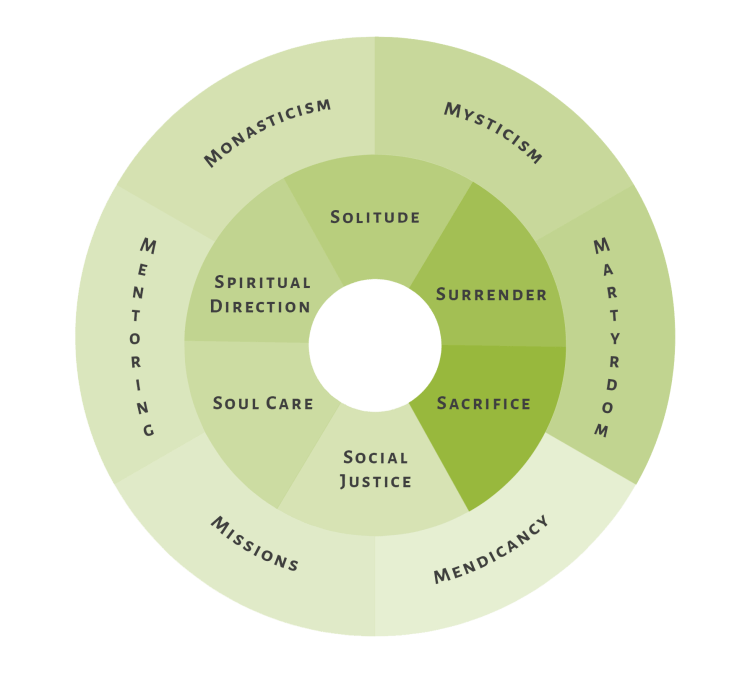
Modes of Christian Experience
Mentoring
Mentoring is the starting point for most in their journey of faith in The Way–the peculiar religion of the followers of Jesus Christ–that would ultimately be called Christianity. Spiritual Direction began in this root form, as seasoned Christ-followers offered guidance to those who were newer in the faith.
Elements: Soul Care, Spiritual Direction
Exemplars: Early Church widows whose role was to teach new converts about the foundations of the faith
Monasticism
Monasticism emerged as many early Christians sought to escape the distractions and influences of the world around them, relocating to the barren desert to adopt a simple, pure life. Often they sought out Spiritual Direction from those who had gone before them–the Desert Fathers–as they came to be known. It is in the desert that these Christians practiced deep Solitude.
Elements: Spiritual Direction, Solitude
Exemplars: Egyptian Coptic Monastery of St. Anthony; Anthony of Egypt
Mysticism
Solitude creates a distraction-free environment where we can more clearly discern the voice of God. Mysticism is centered on the supernatural presence of God and His communication with His people through various practices. Solitude greatly facilitates these encounters with God, where we are often invited to yield, or surrender, something temporal in exchange for receiving something supernatural.
Elements: Solitude, Surrender
Exemplars: Independent French Monastery of Lerins; St. Patrick
Martyrdom
Martyrdom has always been a staple of the Christian experience. Every century has seen persecution by countless oppressors in various countries around the world. Early on, Christians had to adopt an attitude of surrender to this very present possibility, and ultimately view it as a privilege to die as a follower of Jesus. A perspective of life as a Sacrifice has always fueled Christians who truly face this danger around the world.
Elements: Surrender, Sacrifice
Exemplars: the Anabaptists
Mendicancy
Not all Christians who were prepared to be a Sacrifice received the opportunity. But many turned this readiness into an expression of sacrificial-living, renouncing all possessions and living in a state of poverty. Such sacrifice wasn’t escapist–rather it allowed a Christian to exist side-by-side with the down-and-out, becoming champions of Social Justice in ways that met the needs of the oppressed and needy.
Elements: Sacrifice, Social Justice
Exemplars: Syriac Orthodox Sons of the Covenant, Basil of Caesarea
Missions
Missions originally started out as Christians went on “mission” or assignment to a particular place or people in order to share the good news of Jesus Christ. More often than not, these were tradespeople and merchants going about their normal travels, tending to people along the way both physically and economically (Social Justice) and emotionally and spiritually (Soul Care).
Elements: Social Justice, Soul Care
Exemplars: Merchants traveling the Silk Road who brought Christianity to China in the 600’s
 neoOrthodoxy